Wage Growth and Labor Market Dislocation in the Context of Minimum Wage Policy Changes
January 25, 2026
Rising wages can lead to unemployment in theory, especially in perfectly competitive labor markets, but empirical evidence shows that actual effects vary depending on labor market structure, worker skill level, institutional context, and the size of the wage increase.
Estimated Reading Time: 8 minutes ┃Post by Jonathan Myers
Theoretical Dynamics of Wage Increases and Labor Demand
In economic analysis, the relationship between rising wages and unemployment is rooted in classical labor market theory. At its most basic level, economists view the labor market as a market for a traded good: the supply of labor (workers) meets the demand for labor (employers). In a perfectly competitive labor market, equilibrium occurs where the wage rate adjusts so that the quantity of labor supplied equaIn economic analysis, the relationship between rising wages and unemployment is rooted in classical labor market theory. At its most basic level, economists view the labor market as a market for a traded good: the supply of labor (workers) meets the demand for labor (employers). In a perfectly competitive labor market, equilibrium occurs where the wage rate adjusts so that the quantity of labor supplied equals the quantity of labor demanded. If policymakers intervene — for example, by setting a wage floor (such as a minimum wage) above the equilibrium level — the theory predicts that the quantity of labor supplied will exceed the quantity of labor demanded, resulting in unemployment among those workers who cannot secure jobs at the higher wage. This outcome is the fundamental prediction of standard competitive models of labor markets and is emphasized in many introductory economic texts.
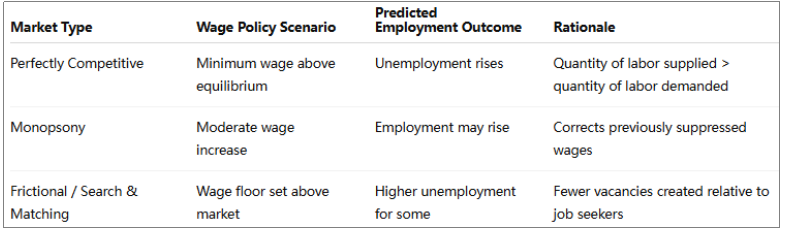
(Table 1- Theoretical Predictions of Wage Increases on Employment)
This theoretical insight is succinctly captured in economist Henry Hazlitt’s exposition on minimum wage laws, which argues that “raising the minimum wage above the market value" can result in increased unemployment because it sets a wage that employers are unwilling to pay for all available workers. Similarly, meta-analytical research that aggregates cross-study evidence finds that a significant portion of empirical studies report negative employment effects from minimum wage increases, particularly for low-skill and entry-level workers. For example, comprehensive reviews show that many credible empirical papers conclude that minimum wage hikes are more often associated with some degree of job losses rather than increased employment.
From a theoretical standpoint, the rationale for wage-induced unemployment emerges directly from the labor demand curve. As the nominal wage — the price of labor — increases, the marginal cost of employing a worker rises. Firms respond by reducing the number of workers hired or by substituting capital or other production methods for labor where feasible. This labor-demand adjustment can manifest in reduced hiring, slower job growth, or layoffs, observable in empirical analyses of episodic wage policy interventions.
Moreover, beyond static competitive models, some labor market theories extend the analysis. For instance, models of search and matching — where job seekers and vacancies must be paired — show that if wages are set above market prices, the friction and cost of matching can result in elevated unemployment because fewer vacancies are created relative to job seekers. In such models, although wage floors may theoretically increase worker welfare under certain contexts, the immediate effect can still be a reduction in labor demand, leading to a higher unemployment rate.

It is important to recognize that these basic economic principles are derived from assumptions about market structure and behavior. Perfect competition assumes that all firms are price takers with no ability to influence wages; the labor force is homogeneous; and there are no frictions in hiring or separations. However, real labor markets often deviate from these assumptions. Firms may exert monopsony power — meaning they have wage-setting power because workers have limited alternatives — or institutional factors like union contracts and wage negotiation frameworks may prevent wages from adjusting downward even when labor demand declines. In these contexts, the theoretical effect of wage increases on unemployment may diverge from the simple competitive model, making the empirical analysis of real-world data essential for understanding actual labor market responses.
Empirical Evidence: When Rising Wages Correlate With Unemployment
The empirical relationship between rising wages and unemployment is complex and varies across studies, contexts, and methodological approaches. A substantial body of empirical research examines the impact of minimum wage increases — the most common policy mechanism that raises wages — on employment outcomes. Contrary to simple theoretical predictions, empirical findings do not uniformly support the conclusion that higher wages always lead to greater unemployment.
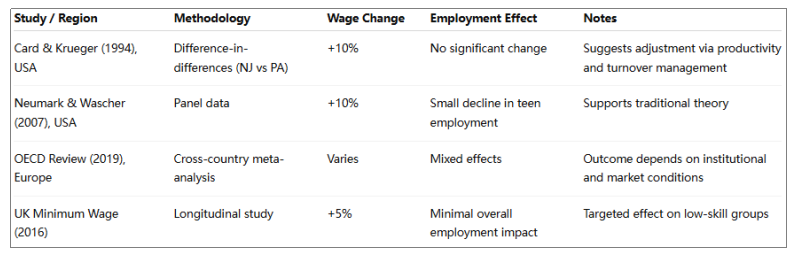
(Table 2- Empirical Findings from Key Minimum Wage Studies)
In the United States and many other countries, numerous studies over decades have investigated whether increases in statutory wage floors cause job losses or raise unemployment. Some of this research finds little to no adverse employment effect. For instance, analyses that compare adjacent geographic areas with differing minimum wage levels — such as counties on opposite sides of state borders — often show that higher minimum wages do not systematically reduce employment relative to control areas with lower wage floors. This body of research suggests that firms adjust to higher wage costs in ways that do not necessarily entail outright reductions in employment levels.
Some scholars argue that the overall labor demand response to minimum wage increases is modest because the costs imposed by wage hikes represent a small share of total labor costs for most employers. In these contexts, wage increases may lead firms to adjust through mechanisms other than layoffs, such as reducing turnover, investing in productivity-enhancing technologies, or cutting non-wage benefits rather than cutting jobs.
However, other empirical evidence supports the more conventional theoretical view that wage increases can reduce employment, particularly for specific worker groups. For example, studies focusing on less-skilled and younger workers have found that minimum wage hikes are associated with notable reductions in employment or labor market opportunities for these groups. These studies often estimate negative employment elasticities, indicating that a 10 percent increase in the minimum wage can correspond to a tangible decline in the labor demand for low-skill workers.
Meta-analytic evidence also highlights that estimated employment effects are heterogeneous. A large review of minimum wage research reveals that only a minority of studies conclude positive employment effects from wage increases, while a significant portion finds negative employment effects, especially when considering studies deemed methodologically robust. This divergence underscores that results are sensitive to empirical strategy, sample periods, and local economic conditions.
International evidence further illustrates the complexity of the wage–employment relationship. Research from European contexts shows mixed outcomes: some minimum wage reforms are associated with minimal employment changes, while others indicate reductions in job opportunities for young or low-skill workers. In some cases, reforms in labor markets with strong institutional protections and active demand side interventions do not exhibit the anticipated negative employment outcomes.
Part of the empirical variation arises from differences in labor market structure. In markets characterized by monopsony power — where employers have disproportionate wage-setting influence — a moderate increase in wages can enhance employment by correcting an existing distortion where wages were previously held too low. In such cases, rising wages may not lead to unemployment because the labor market was not in a competitive equilibrium to begin with. Conversely, in labor markets that more closely approximate competitive conditions, wage floors set above the equilibrium wage are more likely to result in reduced hiring and increased joblessness among affected worker segments.

Longitudinal studies that cover many wage increase episodes also provide insight. For example, analyses that examine multiple instances of minimum wage hikes over time often do not find consistent evidence that higher wage floors worsen aggregate unemployment, especially when macroeconomic conditions and broader labor market trends are controlled for. Yet, targeted analyses of specific demographic groups — such as teenagers or less-educated workers — often detect disemployment effects in those subpopulations.
Policy implications drawn from empirical evidence reflect this nuanced understanding. While some researchers advocate caution in raising wage floors too aggressively — particularly in economies facing structural labor demand weaknesses — others argue that moderate wage increases can improve worker welfare without triggering significant unemployment. Ultimately, the empirical evidence does not support a universal rule that rising wages always lead to higher unemployment; rather, the outcome depends on market structure, institutional frameworks, the size and pace of wage increases, and the broader macroeconomic environment.
(Use of any information published on this blog is at your own risk. In no event shall the author or this blog be liable for any direct, incidental, consequential, or punitive damages arising out of the use of such content.)
Updated February 14, 2026
About the Author
Dr. Jonathan Myers is a labor economist specializing in wage policy, employment dynamics, and labor market modeling. His research focuses on understanding how macroeconomic conditions, institutional frameworks, and market structures influence employment outcomes across diverse economies.
References
[1] American Action Forum. (2024). What the weight of minimum wage research shows.
[2] Federal Reserve Bank of Cleveland. (2007, May 1). The minimum wage and the labor market.
Before you go, check out more of our content to keep your marketing skills sharp and ideas flowing!