Can the Economy Thrive in Harmony with Nature?
April 7, 2026
Key Points
● Economic growth has traditionally relied on resource exploitation, raising questions about sustainability.
● Renewable energy, circular economies, and green innovation are central to a nature-compatible economy.
● Governments and corporations play critical roles in aligning economic goals with ecological health.
● A harmonious economy is not just idealistic; it can enhance resilience, productivity, and social well-being.
Estimated Reading Time: 12 minutes ┃Post by Clara Hastings
The question of whether the economy can thrive in harmony with nature has never been more urgent. Across the globe, policymakers, business leaders, and citizens grapple with the challenge of balancing economic growth with environmental stewardship. Historically, industrial and post-industrial economies prioritized short-term gains, often at the expense of natural ecosystems. The resulting consequences—climate change, biodiversity loss, and resource depletion—highlight the urgent need for a reimagined economic model.
The Traditional Economic Paradigm and Its Limits
For centuries, economic development followed a linear model: extract, produce, consume, and discard. While this framework generated immense wealth and technological advancement, it also imposed significant costs on the planet. Natural resources, once considered abundant and inexhaustible, now face critical depletion. Forests are cleared at alarming rates, oceans overfished, and freshwater systems stressed by industrial use. The traditional paradigm has often treated environmental degradation as an externality, not a central economic concern. However, ignoring ecological limits threatens not only natural systems but also the long-term stability of economic markets themselves.
The Emergence of Nature-Compatible Economies
In recent decades, the concept of a nature-compatible economy has gained traction. This approach emphasizes the integration of ecological principles into economic decision-making. Core strategies include renewable energy adoption, resource efficiency, sustainable agriculture, and the promotion of circular economies where waste is minimized, and materials are continually reused. For example, companies shifting to solar and wind energy reduce dependency on fossil fuels while stimulating new industries and jobs. Similarly, circular practices in manufacturing—from electronics to fashion—lower environmental impacts while generating economic opportunities through innovation and design.
Renewable Energy as a Growth Engine
Energy production remains central to the debate on sustainable economies. Renewable sources such as solar, wind, hydro, and geothermal not only reduce carbon emissions but also create resilient, decentralized energy systems.
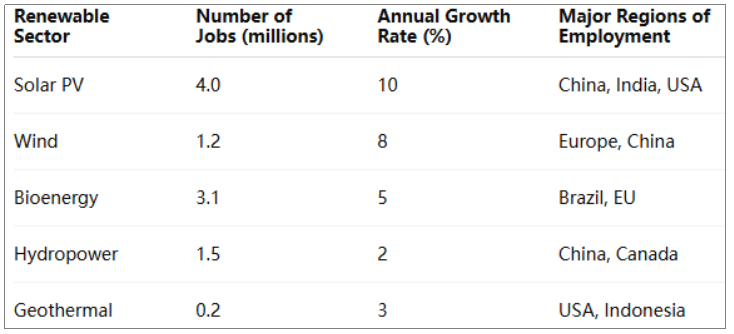
(Table 1- Global Renewable Energy Employment)
Investment in renewables has proven to be economically beneficial; for instance, the global solar industry alone employs over 4 million people and continues to expand rapidly. As technology costs decrease, green energy becomes increasingly competitive with traditional fossil fuels, challenging the notion that environmental responsibility and economic growth are mutually exclusive.
Circular Economy and Resource Efficiency
A circular economy redefines how businesses approach production and consumption. Unlike the linear model, it emphasizes keeping materials in use for as long as possible and regenerating natural systems. Examples include re-manufacturing, product leasing, and industrial symbiosis, where the waste of one process becomes the input for another. This model not only reduces ecological damage but also lowers costs, drives innovation, and strengthens supply chain resilience. Companies embracing circularity often gain competitive advantages by appealing to environmentally conscious consumers while securing more predictable access to resources.
Policy and Governance: Catalysts for Harmony
Governments play a pivotal role in aligning economic growth with environmental sustainability. Policies such as carbon pricing, subsidies for clean technologies, and stricter environmental regulations create incentives for businesses to innovate responsibly. Furthermore, international agreements—such as the Paris Climate Accord—set global frameworks that encourage cooperation and accountability. Effective governance ensures that the benefits of green growth are distributed equitably, preventing environmental policies from disproportionately burdening marginalized communities. Collaborative approaches between public and private sectors can accelerate the transition toward a nature-compatible economy.
Corporate Responsibility and Social Innovation
Modern corporations increasingly recognize that long-term profitability is intertwined with ecological health. Environmental, social, and governance (ESG) strategies are no longer optional; they are integral to investment decisions, brand reputation, and operational efficiency. Companies that prioritize sustainable supply chains, ethical sourcing, and reduced emissions often experience enhanced customer loyalty and investor confidence. Beyond environmental compliance, businesses can drive social innovation—developing products and services that improve both quality of life and environmental outcomes, from biodegradable packaging to urban green infrastructure.
Challenges and Trade-offs
Transitioning to an economy in harmony with nature is not without challenges. Short-term costs, technological limitations, and societal inertia can slow progress. For developing nations, balancing poverty reduction with ecological stewardship requires careful planning. There is also the risk of "greenwashing," where companies overstate their sustainability credentials without substantial environmental impact. Overcoming these obstacles demands transparency, data-driven decision-making, and robust public engagement.
Economic Resilience Through Ecological Integration

Long-term economic resilience increasingly depends on ecological integration. Natural disasters, resource scarcity, and climate-induced disruptions can undermine markets and supply chains. A nature-compatible economy reduces vulnerability by investing in ecosystem restoration, sustainable agriculture, and renewable infrastructure. Furthermore, it opens opportunities for innovation in sectors such as clean technology, sustainable finance, and regenerative design, creating jobs and stimulating growth while safeguarding environmental capital.
The economy can indeed thrive in harmony with nature, but it requires a fundamental shift in how societies value and interact with the natural world. By embracing renewable energy, circular economies, responsible governance, and corporate sustainability, it is possible to achieve growth that supports both people and the planet. Economic prosperity need not come at the expense of environmental health; rather, it can be strengthened by integrating ecological principles into every facet of economic life. The challenge is immense, but the potential rewards—resilient markets, vibrant communities, and a stable climate—make it an imperative worth pursuing.
(The views expressed in this article reflect the author’s research and interpretation of current economic and environmental trends. They are not intended as financial advice. Readers should consult professional advisors for specific guidance.)
FAQs:
1: Can green
technologies realistically replace fossil fuels in the near
future?
While the transition may take decades, technological advancements and
decreasing costs of renewables make large-scale replacement increasingly feasible.
2: Are circular
economies financially viable for small businesses?
Yes, many small businesses benefit from reduced
material costs, enhanced brand loyalty, and access to niche markets focused on
sustainability.
3: How can
individuals contribute to a nature-compatible economy?
Individuals can support sustainable products,
reduce waste, conserve energy, and advocate for environmentally responsible
policies.
About Author
Clara Hastings is an economist and environmental strategist with over 15 years of experience studying sustainable development and green finance. She has advised governments and corporations on integrating ecological considerations into economic planning.
References
[1] World Economic Forum. (2023). The future of green economies.
[2] International Renewable Energy Agency. (2022). Renewable energy employment statistics.
[3] Ellen MacArthur Foundation. (2021). Circular economy overview.
Explore more insights and expert perspectives on economic trends and sustainability by staying with our blog!