Winning Consumers Around the World Through Cultural Understanding
January 23, 2026
Key Points:
● Understanding cultural codes is essential for brands to connect meaningfully with consumers in different international markets.
● Effective global marketing goes beyond language translation to incorporate deep insights about local traditions, values, and behaviors.
● Successful brands adapt products, messaging, and engagement strategies to align with cultural preferences in each region.
● Missteps in cultural adaptation can lead to poor consumer reception or backlash, underscoring the importance of cultural fluency.
● Continuous cultural research and iterative campaign refinement help brands maintain relevance and resonance worldwide.

Estimated reading time: 8.1 minutes┃Post by Sophia Reed
In an era defined by rapid globalization and digital interconnectedness, brands are increasingly recognizing that international success depends on far more than translating slogans or adapting creative. For contemporary marketers, the real work begins with understanding cultural codes — the deep, often implicit frameworks that shape how consumers interpret messages, define value, and make purchasing decisions. Cultural codes encompass a range of phenomena, from communication styles and social norms to symbolism and collective values. These codes are not uniform across markets; what resonates in one region may be neutral or even offensive in another, making cultural fluency a strategic imperative rather than an optional enhancement to campaign execution.
Cultural Insight as
a Strategic Imperative
Research underscores this shift. Studies on cultural influence in global
marketing highlight that cultural elements such as traditions, religion, language nuances, and
social behavior significantly shape marketing strategy effectiveness. Without adaptation to
these elements, campaigns risk rejection or may fail to connect with local consumers in
meaningful ways. This is especially true when brands enter markets with high-context cultures,
where communication relies on subtlety and shared understanding, compared to low-context
cultures that favor direct, explicit messaging.

Global brands that have mastered cultural insight move beyond superficial localization and integrate deeper cultural understanding into strategic planning. This integration affects not only advertising language and imagery but also how products are positioned, how storytelling is framed, and how consumer engagement is cultivated. Cultural research has become essential in this context — market studies, local focus groups, and collaborations with cultural experts offer insights that shape campaigns so they reflect authentic consumer values rather than generic global narratives.
Cultural fluency also intersects with behavioral economics and psychology. The country-of-origin effect, for example, illustrates how consumers" perceptions of a product’s origin can influence attitudes and purchasing decisions, reinforcing that culture extends into the very ways consumers perceive brand legitimacy and desirability. Brands that neglect such dimensions and rely solely on translations often discover that language alone cannot bridge the divide; instead, the message must be “transcreated" to preserve emotional resonance while maintaining brand intent across cultural boundaries.

Navigating Cultural
Codes in Practice
The practical implications of cultural nuance are evident in how major
global brands adapt their marketing strategies in diverse markets. These adaptations are far
more than cosmetic; they demonstrate respect for local customs, values, and consumption
contexts, aligning brand narratives with consumer worldviews rather than imposing a monolithic
global identity.
Consider the approach taken by McDonald’s. While the golden arches remain a global symbol, the company adjusts its menu to align with local dietary preferences and cultural norms. In India, where a large part of the population follows vegetarian diets for religious and cultural reasons, McDonald’s offers the McAloo Tikki and other vegetarian options. In contrast, in Japan, the brand has introduced items like the Ebi (shrimp) Filet-O to reflect regional tastes and consumer expectations. Such product-level adaptations signal that the brand is listening to — and respecting — local consumer behaviors and gastronomic preferences.
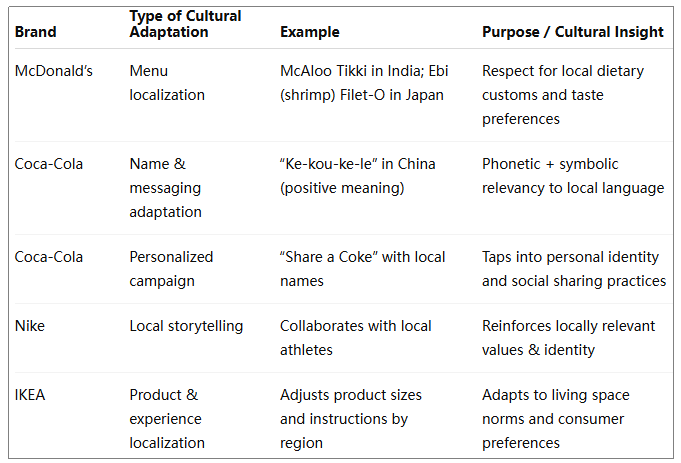
(Table 1 — Examples of Cultural Adaptations by Global)
Similarly, Coca-Cola’s campaigns illustrate how culturally informed messaging can elevate brand resonance. The “Share a Coke" campaign, which replaced the iconic logo with popular local names on bottles, succeeded because it tapped into cultural practices around personal identity and social sharing. In markets such as China, where names and phrases differ significantly in cultural meaning and social use, Coca-Cola adapted the textual elements to ensure relevance and avoid misinterpretation, demonstrating the importance of culturally sensitive customization.
Other global players tailor not only products but also storytelling and engagement strategies to cultural expectations. Nike, for instance, often collaborates with local athletes and cultural figures to reinforce locally relevant values around aspiration, achievement, and identity. This localized storytelling fosters emotional connections that transcend basic product promotion and reflect cultural narratives that matter to consumers.
Beyond product and messaging adaptations, distribution channels and consumer touchpoints also reflect cultural considerations. Different markets may favor distinct social platforms, media consumption habits, or retail environments, which requires customization of campaign delivery in addition to content. Aligning marketing investment with culturally preferred channels increases relevance and amplifies engagement.
Yet, the stakes of misreading cultural codes can be high. Numerous global brands have faced backlash or diminished effectiveness due to culturally insensitive or poorly localized campaigns. Historical missteps — from mistranslations that conveyed unintended meanings to ad concepts that misunderstood cultural symbols — highlight how even well-intended campaigns can fail without deep cultural insight.

At the heart of these examples is the recognition that cultural nuance is not a static checklist but a dynamic set of lived experiences and meanings. Successful marketing in global contexts involves continuous learning, iteration, and responsiveness to cultural trends and shifts. Marketers increasingly integrate real-time consumer feedback and performance data to refine campaigns, ensuring that cultural alignment is sustained rather than assumed.
In sum, decoding cultural codes operationally requires that brands commit to more than translation: they must engage in culturally informed strategy development, localized creative production, and ongoing cultural intelligence gathering. This depth of understanding enables brands to resonate authentically with consumers worldwide, elevating international campaigns from generic to genuinely connective and contextually relevant.
(Market trends discussed here are observational and not recommendations to buy, hold, or sell any asset or product.)
Updated February3, 2026
FAQs
1. Why is cultural insight more important than just translating advertising?
Translation alone doesn’t capture the emotional, symbolic, or contextual meaning behind messages. A campaign that works in one market can be misunderstood or even offensive in another without cultural insight. This is because cultural norms shape how messages are interpreted, not just what words are used.
2. What are some examples of cultural adaptation in marketing?
McDonald’s: Adapts menus to fit dietary norms — e.g., vegetarian items in India, seafood items in Japan — to reflect local eating habits.
Coca‑Cola — “Share a Coke" Adjusted names and phrases on bottles to align with local language customs and avoid misinterpretation.
Nike: Collaborates with local athletes and cultural figures to tell stories that resonate with local values and aspirations.
References
[1] OmniFunnel Marketing. (2025, April 7). Understanding cultural sensitivity in global marketing strategies.
[2] Novobritskii, A. (2026). Intercultural communication strategies of a technology brand: A comparative quantitative analysis of Xiaomi’s digital marketing in China and Russia
[3] Winsome Marketing. (2025, March 31). Cultural linguistics in global marketing: When words don’t translate.
Enjoyed this insight? Take a few minutes to explore more of our marketing strategies, case studies, and industry tips!